
Why Ad Funnels Break When You Scale Campaigns
26.05.2026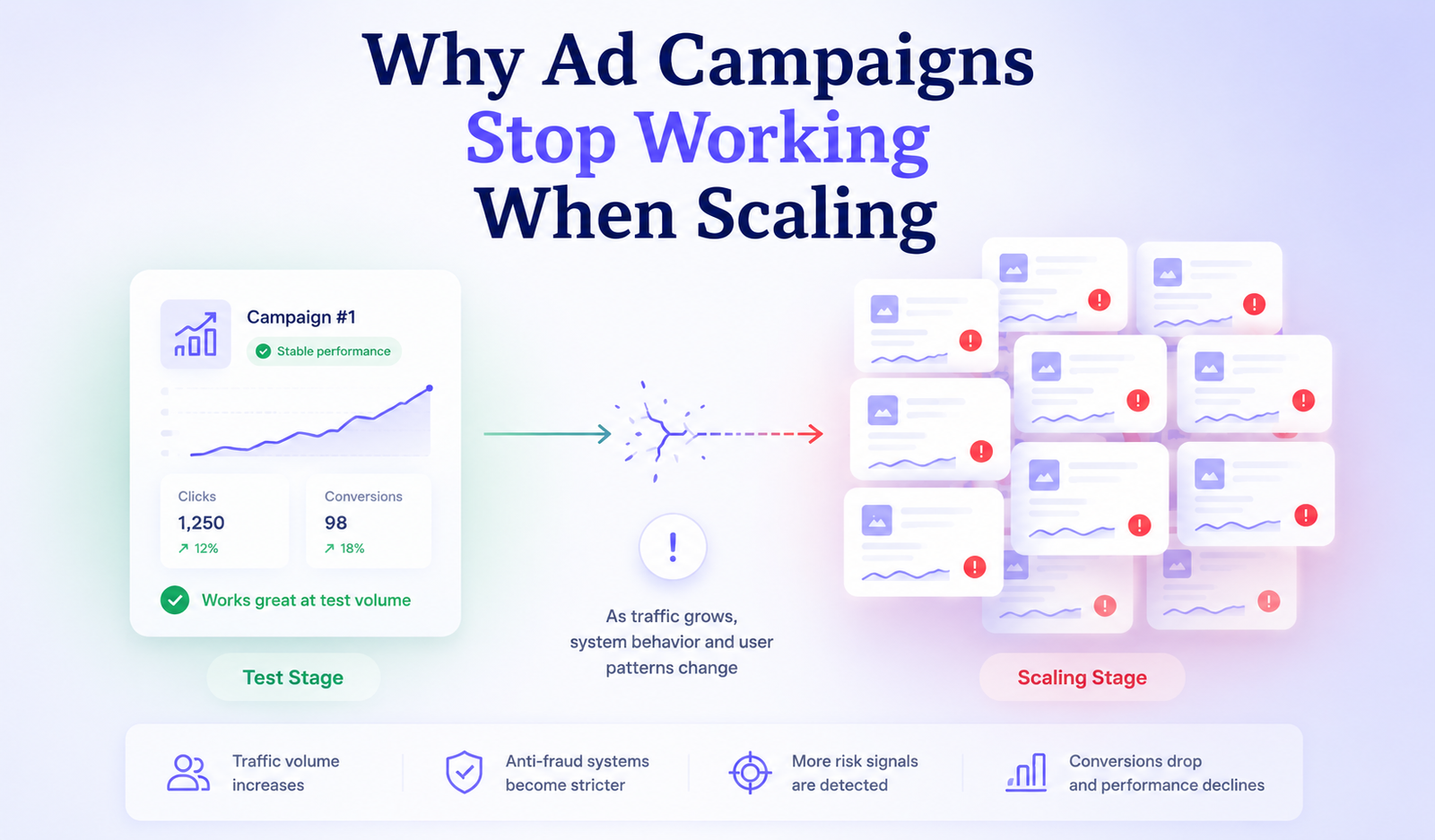
When a funnel starts delivering results, the first instinct is to scale. More accounts, more campaigns, more geos. It feels logical. If one launch produces a solid ROAS, ten identical launches should produce proportional growth.
But this is exactly where most teams run into something that can't be explained by analyzing creatives or offers alone.
The funnel that was performing confidently at test volumes starts breaking down. Metrics drop. CTR falls without any visible reason. Accounts hit restrictions earlier than usual. The team starts suspecting the creative, then changes the offer, then starts re-testing audiences from scratch. This can go on for weeks — with no clear understanding of what actually broke.
The problem is almost never the funnel itself.
What a Funnel Actually Is from the System's Point of View
In the standard framing, a funnel is a creative plus a landing page plus an offer. Sometimes an audience and a geo get added to that. But the platform sees something quite different.
From the advertising system's perspective, a funnel is a signal. And that signal is formed not just from the elements themselves, but from the environment in which they operate. The account the traffic comes from. Its activity history. The IP it's managed through. Session behavior around the launch. The consistency of actions inside the ad account. All of this combines into a profile that the platform begins evaluating in parallel with the ad itself.
At small scale, this is barely noticeable. One account, one launch — the system runs standard learning and starts optimizing. But when new accounts, new devices, different IP environments, and different activity patterns get added to the mix — the signal starts to blur. What previously read as an organic launch becomes a collection of inconsistent traffic sources.
That's why funnels don't "die" — they lose legibility for the system.
What Actually Happens When Volume Grows
Most teams scale intuitively: take what worked and duplicate it. Copy the campaign, move it to a new account, change the geo, launch. The logic is obvious.
The problem is that this only works if the infrastructure around each new launch is identical to the original — or at least compatible with it in terms of signal quality.
In practice, that's almost never the case. New accounts have different histories, or none at all. IP segments vary in quality and behavior. Some accounts were warmed up properly, others superficially or not at all. Sessions are managed from different devices, sometimes through the same access point. What looks like "ten launches of the same funnel" is perceived by the platform as ten different traffic sources with different trust levels.
That's the difference between scaling as replication and scaling as a system.
| Approach | What Happens at Scale |
| Duplicating without infrastructure alignment | Signal dilution, inconsistent results across accounts |
| Different IP segments for different accounts | Unpredictable campaign learning, metric asymmetry |
| Uneven account warmup | Some campaigns learn, others stall or hit restrictions |
| Consistent setup logic across horizontal growth | Predictable system behavior, manageable traffic |
Where the Breakdown Actually Starts
If you try to identify the moment when scaling begins to break a funnel — it's usually not one specific failure. It's an accumulation of small, barely visible inconsistencies.
The first two or three accounts work fine because the team is still controlling each of them manually. IPs are selected carefully, warmup is done, account histories are roughly aligned. Then the fifth, seventh, tenth account gets added — and the level of control inevitably drops. Accounts start appearing that were warmed up using a simplified scheme. Proxies get swapped out because the old ones are occupied or exhausted. Someone on the team is working from a different device.
None of these factors is a catastrophe on its own. But together they start to generate what could be called "infrastructure noise." The platform sees a growing inconsistency, and system behavior shifts — sometimes gradually, sometimes abruptly.
Another common pattern: expanding to new geos. The team takes a funnel that's been performing stably in one region and starts rolling it out across three or four new ones. Offers are adapted, copy is translated, audiences are set up. But the IP environment in the new geos differs in quality. The local account history, if it exists at all, doesn't match the expected profile. Session behavior is different. The funnel behaves in a completely different way — not because the audience is different, but because the infrastructure context has changed.
Signs the Problem Is Structural, Not Advertising
One of the hardest things about working at scale is learning to distinguish symptoms from causes. Teams frequently diagnose advertising problems where the actual issue is infrastructural.
Here are the signals that in practice point specifically to a structural breakdown:
- Different accounts running the same campaign show dramatically different results under identical settings
- Metrics on new launches are unstable in the first 48–72 hours, then either stabilize or don't stabilize at all
- New geos produce sharply different CPM/CPL with no obvious explanation in audience data
- Campaigns hit restrictions or see reach decline immediately after new accounts are added to the setup
- Testing the same ad in two accounts with different IP segments produces fundamentally different learning outcomes
This doesn't mean the creatives are fine. But if these patterns appear consistently, the problem is probably elsewhere.
Three Scenarios That Come Up Most Often
First. A four-person team successfully launches a funnel across three accounts. Everything is working — learning progresses, conversions are stable, ROAS is solid. A decision is made to scale to twenty accounts within a week. The first five new ones are still fine. Starting from the sixth or seventh, results begin to diverge. Several accounts don't learn at all. The team starts swapping creatives, which adds more noise to the learning process. Two weeks later, eight out of twenty accounts are performing normally; the rest are either restricted or producing unstable metrics. The issue turned out to be that all new accounts received the same IP segment from a pool that had already been partially used by other campaigns. The warmup was also done using a simplified scheme — fast, without proper behavioral simulation.
Second. A team launches a funnel into a new geo — a market with solid potential and genuinely responsive audiences. They translate the landing page and adapt the copy. They launch with the same settings they used in their home geo. CPM looks normal for the first few days, clicks are coming in. But at the conversion level, everything is highly unstable — sometimes good, sometimes nearly zero. The tracker shows normal traffic quality throughout. It turns out the proxy segment being used to manage accounts in that region is a datacenter that the platform knows very well. Sessions look non-standard for local traffic. The system starts downgrading impression quality. After switching to a mobile infrastructure with real IPs from the target region, performance stabilizes within a week.
Third. A small team is testing several hypotheses simultaneously: five different funnels across the same accounts, because no new accounts are available. Each funnel affects the learning of the next. Accounts start receiving mixed signals. Some campaigns can't learn properly because the budget keeps switching between hypotheses too frequently. In the end, none of the five funnels gets enough data for the system to optimize properly. The team concludes all five hypotheses are weak. The actual problem was that they were being tested in conditions where normal learning was structurally impossible from the start.
How Teams That Scale Without Breaking Funnels Actually Work
The difference between teams that scale stably and those that constantly run into funnel failures as volume grows is almost always in how the infrastructure is organized — not in how good the funnels are.
Mature teams build around a few principles that eventually become automatic.
First — account role separation. Not every account does everything. There are accounts for hypothesis testing, accounts for scaling proven funnels, and accounts for new geos. This prevents the situation where an active test contaminates an established campaign and starts interfering with its learning.
Second — a consistent warmup approach. This might sound obvious, but in practice it means every account in the system has gone through the exact same sequence of actions before any real campaigns go live. Not "roughly the same" — literally the same, in terms of timing, actions, and session behavior.
Third — IP environment control. Each account or group of accounts gets a dedicated IP segment that doesn't overlap with other active launches. This is one of those areas where proxy infrastructure quality affects system behavior more than it initially appears.
The difference between good and poor proxy infrastructure at scale isn't just a question of connection speed or stability. It's about how natural the IP environment looks to the platform in a specific geo. Overloaded public pools create several problems simultaneously: the same address appears across dozens of different accounts, the IP history is already contaminated by other users' previous campaigns, and session behavior looks atypical for real mobile traffic. This is precisely what becomes the source of that "infrastructure noise" — difficult to diagnose, but reliably degrading campaign learning quality.
AI-oriented infrastructures built on real SIM cards and proprietary modem farms — as opposed to reseller solutions — produce a fundamentally different picture. Proxies.sx operates on this model: proprietary hardware without reselling capacity, an SDK network of real devices, and daily IP rotation sourced from live carrier environments. This means each account receives an address that looks like an ordinary mobile user from the target region — without the history of other users' campaigns and without the patterns that platforms have long learned to identify as anomalous. For teams operating simultaneously across multiple geos with dozens of accounts, this isn't optional — it's a baseline element of the setup. The pay-per-used-traffic billing model — rather than time-based rental — further simplifies budget management when launch volumes are unpredictable. REST API integration and MCP support covers the needs of teams with automated workflows, where manually switching between segments simply doesn't fit the operational rhythm.
Fourth — limiting the number of active hypotheses per infrastructure unit. A solid rule of thumb: no more than two or three active tests per account group sharing an IP segment. Beyond that, interference between learning campaigns begins to accumulate.
Why "A Successful Launch" Is a Poor Unit of Measurement
If a team evaluates its work through the lens of "we found a working funnel," that's itself a sign of vulnerability at scale.
One successful launch is a single data point under conditions that are very difficult to reproduce exactly. The account was in a particular state. The IP was clean. The warmup had just been completed. The prior history wasn't creating interference. Learning was running without competing signals.
When all of that aligns — the funnel works. Trying to scale it without reproducing those conditions is essentially a bet that all the new accounts will coincidentally end up in a similar state. Sometimes that happens. Often it doesn't.
A mature approach to scaling isn't "find a funnel and multiply it." It's "create the conditions under which the funnel performs predictably, and replicate the conditions." That's what turns scaling into a managed process instead of a lottery.
| Indicator | Funnel as a Find | Funnel as a System |
| Basis of results | Coincidence of conditions | Reproducible infrastructure |
| Response to scale | Unstable, luck-dependent | Predictable, manageable |
| Diagnosis when performance drops | Swap creative / offer | Audit the infrastructure layer |
| Planning horizon | Current launch | System of launches |
FAQ
Why does a funnel that works across three accounts break across twenty?
Most likely, the first three accounts happened to be in similar infrastructure conditions — matching warmup level, comparable IP context, aligned activity history. When new accounts are added, that alignment disappears. Each new account is a new signal for the platform, and if those signals diverge from each other, the system learns differently on each one. The result is asymmetry that's hard to interpret without understanding the infrastructure context.
Is it possible to scale properly without separating accounts by role?
At small volumes — yes, and many teams do. But as volume grows, mixing roles starts generating noise in the learning process. When test campaigns and scaling campaigns share the same account, they compete for data. This is especially noticeable in budget-constrained accounts — the system simply doesn't have enough data to properly learn any of the campaigns.
How do you tell if the problem is in the proxy infrastructure rather than the audiences or creatives?
One practical test: run the same campaign on two accounts with different IP environments. If results diverge significantly under identical settings, that's a strong signal pointing to an infrastructure issue. Another indicator is abnormally unstable learning in the first 48 hours when launching into a new geo, while the same campaign learned normally in the home region.
Why does adding a new geo often break what was working in the primary region?
Because the platform evaluates not just the traffic itself, but the quality of the environment from which the account is managed in the context of that geo. If the proxy segment an account runs through looks atypical for the target region, the system picks up on it. This is especially critical for competitive geos, where the platform has enough data to assess incoming requests with more precision.
How many hypotheses is it reasonable to test simultaneously within one infrastructure unit?
It depends on budget and traffic volume, but the general practice is no more than two or three active tests per account group sharing an IP segment. Beyond that, interference kicks in — campaigns compete for data, learning stalls, and results start looking worse than they actually are.
What should you do if the funnel breaks every time you scale, despite changing the creatives?
That's a signal to stop looking at the ads and start looking at the infrastructure. Check how consistent the launch conditions are across accounts. How stable the IP environment is. Whether all accounts went through the same warmup process. Sometimes bringing infrastructure parameters to a unified standard is enough — and the same funnels start working.
In Closing
The industry tends to treat funnels as inherently temporary. A funnel works — use it. It stops — find another one. This creates the impression that instability at scale is normal, expected behavior.
But if you look at teams that operate at high volumes consistently over long periods, the pattern is different. They don't replace funnels less frequently than everyone else. They simply build the infrastructure around each funnel in a way that keeps its behavior predictable as volume grows. And when something breaks — they know where to look.
Scaling problems are almost never about a funnel becoming outdated. More often, the funnel simply found itself in an environment that wasn't built to reproduce it. That's why stability at scale is fundamentally an infrastructure problem — not an advertising one.
Users of Proxies.sx can apply promo code WELCOME15 for 15% off their first order.